Taylor Drop Test Kit, Chlorine (free/combined), FAS-DPD, 1 drop = 0.2 or 0.5 ppm, 2 oz
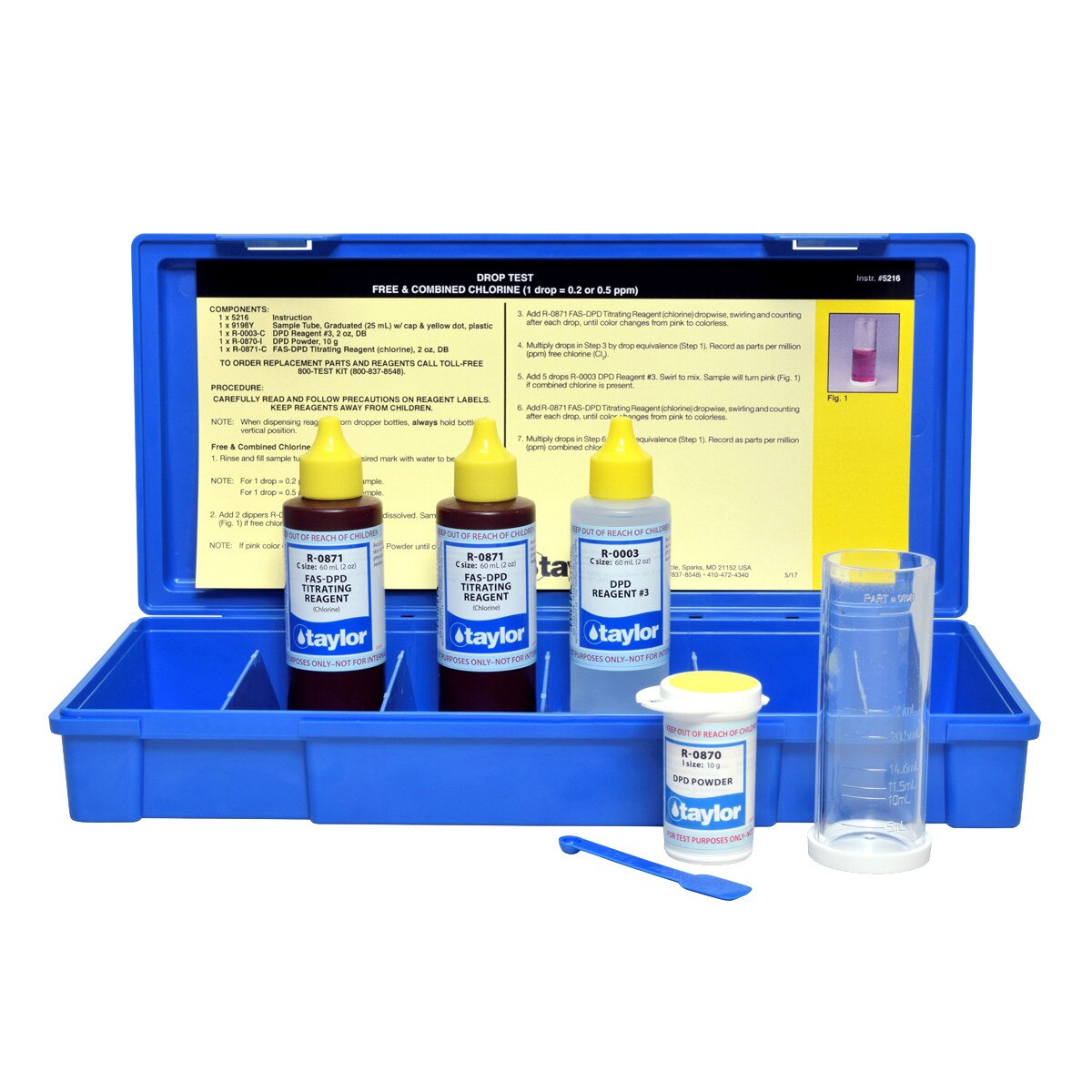
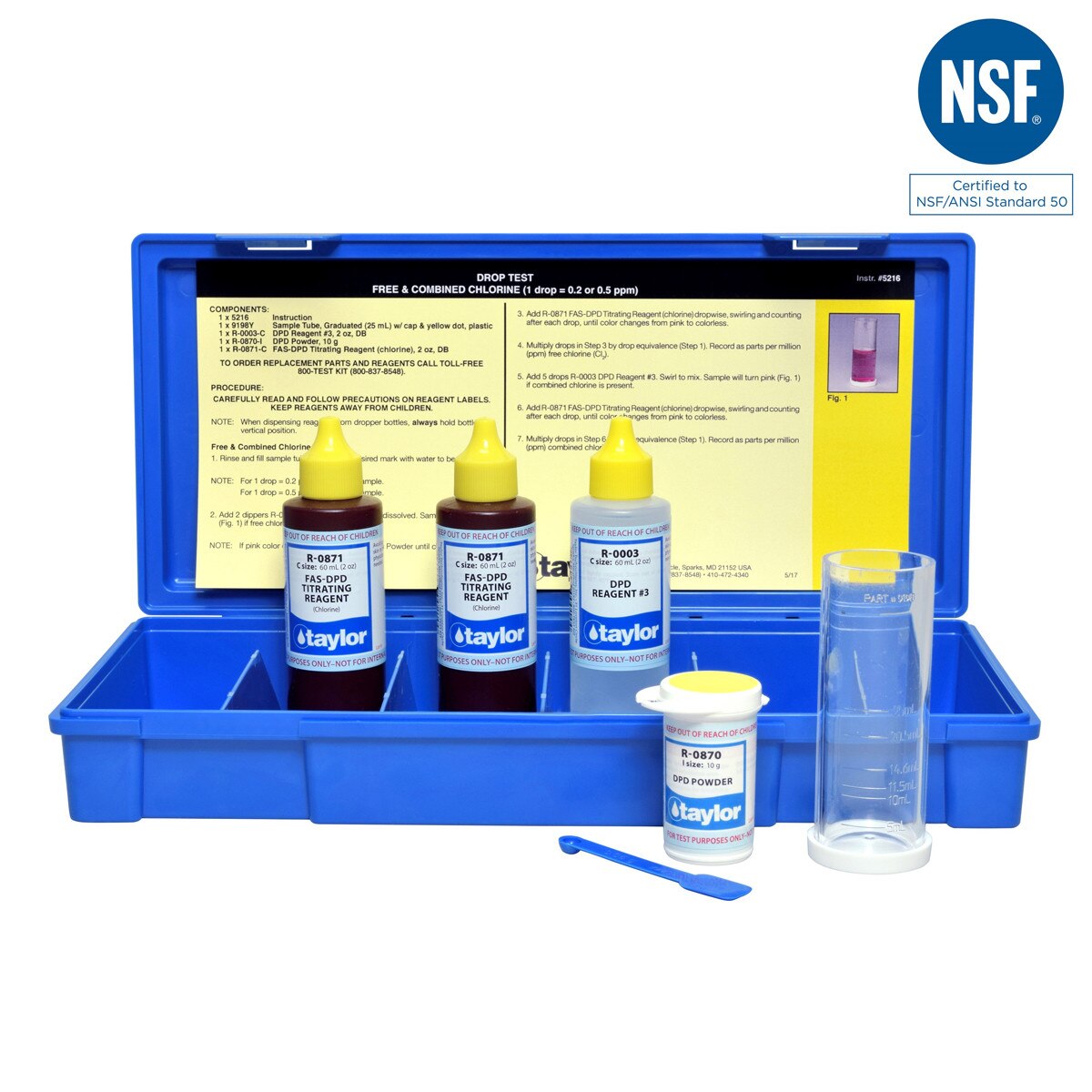
Images are for representation only. Actual product may differ in size, color or options.
Taylor Drop Test Kit, Chlorine (free/combined), FAS-DPD, 1 drop = 0.2 or 0.5 ppm, 2 oz
In recent years, professionals in the pool and spa industry have progressed from using orthotolidine (OT) to N,N-diethyl-p phenylene-diamine (DPD) when determining chlorine levels with color-matching tests.
The OT method only measures total chlorine (the sum of active and spent sanitizer) which makes maintaining the correct residual a guessing game. Because of this, regulatory authorities do not permit OT testing in commercial pools. In addition, orthotolidine contains hydrochloric acid, making it more costly to ship than DPD and therefore more costly to buy.
Unlike OT, the DPD method will distinguish between free available chlorine and total chlorine. By subtracting the free chlorine reading from the total chlorine reading, the amount of combined chlorine in the water can be known. Combined chlorine is not an effective sanitizer. Its presence causes eye and mucous membrane irritation and the characteristic “chlorine” odor of a poorly maintained pool.
Combined chlorine is eliminated by superchlorination. Calculations for the breakpoint dosage depend on knowing the level of combined chlorine in the water, which is why the DPD method is superior to the OT method for testing chlorine-sanitized pools. However, bromine is an effective sanitizer in all its forms. Because of this, either OT or DPD may be used to test bromine pools and spas.
The latest trend in commercial pools with chlorine sanitizer has been the FAS-DPD titration method, which can measure free and combined chlorine as low as 0.2 ppm (using a 25 mL sample size) and as high as 20 ppm (using a 10 mL sample size).
To get the free chlorine reading, a buffered DPD indicator powder is added to the water sample. It reacts with the chlorine to produce the pink color characteristic of the standard DPD test. Ferrous ammonium sulfate (FAS) titrating reagent is then added until the pink color permanently disappears, signaling the endpoint.
The distinct change from a vibrant pink to no color at all eliminates the need for color matching. This feature comes in handy when testing samples with high levels of sanitizer because the user does not have to distinguish between relatively close printed-color gradations. This test is also a boon for colorblind users.
The second half of the FAS-DPD test determines the amount of combined chlorine present. It too involves turning the sample from a vibrant pink to a colorless endpoint.
FAS-DPD is available in stand-alone kits to measure chlorine or bromine, and in combination with other common tests. Supplement this test with Deox Reagent when testing chlorine in the presence of monopersulfate shocks or interference will cause a false-high combined chlorine reading.
In recent years, professionals in the pool and spa industry have progressed from using orthotolidine (OT) to N,N-diethyl-p phenylene-diamine (DPD) when determining chlorine levels with color-matching tests.
The OT method only measures total chlorine (the sum of active and spent sanitizer) which makes maintaining the correct residual a guessing game. Because of this, regulatory authorities do not permit OT testing in commercial pools. In addition, orthotolidine contains hydrochloric acid, making it more costly to ship than DPD and therefore more costly to buy.
Unlike OT, the DPD method will distinguish between free available chlorine and total chlorine. By subtracting the free chlorine reading from the total chlorine reading, the amount of combined chlorine in the water can be known. Combined chlorine is not an effective sanitizer. Its presence causes eye and mucous membrane irritation and the characteristic “chlorine” odor of a poorly maintained pool.
Combined chlorine is eliminated by superchlorination. Calculations for the breakpoint dosage depend on knowing the level of combined chlorine in the water, which is why the DPD method is superior to the OT method for testing chlorine-sanitized pools. However, bromine is an effective sanitizer in all its forms. Because of this, either OT or DPD may be used to test bromine pools and spas.
The latest trend in commercial pools with chlorine sanitizer has been the FAS-DPD titration method, which can measure free and combined chlorine as low as 0.2 ppm (using a 25 mL sample size) and as high as 20 ppm (using a 10 mL sample size).
To get the free chlorine reading, a buffered DPD indicator powder is added to the water sample. It reacts with the chlorine to produce the pink color characteristic of the standard DPD test. Ferrous ammonium sulfate (FAS) titrating reagent is then added until the pink color permanently disappears, signaling the endpoint.
The distinct change from a vibrant pink to no color at all eliminates the need for color matching. This feature comes in handy when testing samples with high levels of sanitizer because the user does not have to distinguish between relatively close printed-color gradations. This test is also a boon for colorblind users.
The second half of the FAS-DPD test determines the amount of combined chlorine present. It too involves turning the sample from a vibrant pink to a colorless endpoint.
FAS-DPD is available in stand-alone kits to measure chlorine or bromine, and in combination with other common tests. Supplement this test with Deox Reagent when testing chlorine in the presence of monopersulfate shocks or interference will cause a false-high combined chlorine reading.
| Analyte | System | Method/Chemistry | Standard/Equivalence or Description | Comparator | Cell |
|---|---|---|---|---|---|
| Chlorine, Free & Combined | Drop test | FAS-DPD (2 oz) | 1 drop = 0.2 or 0.5 ppm chlorine (Cl₂) | NA | 9198Y |
| Product Type: | Test Kit |
| Brand: | Taylor Technologies |
| Product Line: | Drop Test |
| Class: | Chlorine (free, combined) (2 oz) |
| Range: | 1 drop = 0.2 or 0.5 ppm |
| Includes: | 1 of the 2101: LABEL,1 1/16 DIA PMS 102Y 1 of the 5216: INSTR,DT,CL,FAS-DPD,DR=0. 1 of the 7040K: LABEL,KIARO PRINTER,2.5"X 1 of the 7060: CASE,DT,RIB,11.5X5.125X2, 1 of the 8126: KIMPAC 4.75 X 11 1 of the 9198: SAMPLE TUBE,GRAD(25 ML) W 1 of the R-0003-C: DPD RGT #3,2 OZ,DB 1 of the R-0870-I: DPD PDR,10 G 2 of the R-0871-C: FAS-DPD TITR RGT,2 OZ,DB |
| Notes: | Taylor items have a lead time of 3-15 days. |
Click Here to go to Taylor Technologies web site for additional product information.
 | Taylor FAS-DPD Drop Tests Brochure.pdf |
| Taylor Food and Beverage Test Kits Brochure.pdf |
| Taylor K-1515-C Instruction Maunal.pdf |
| Taylor Industrial-Commercial Water Treatment Testing Products Catalog.pdf |