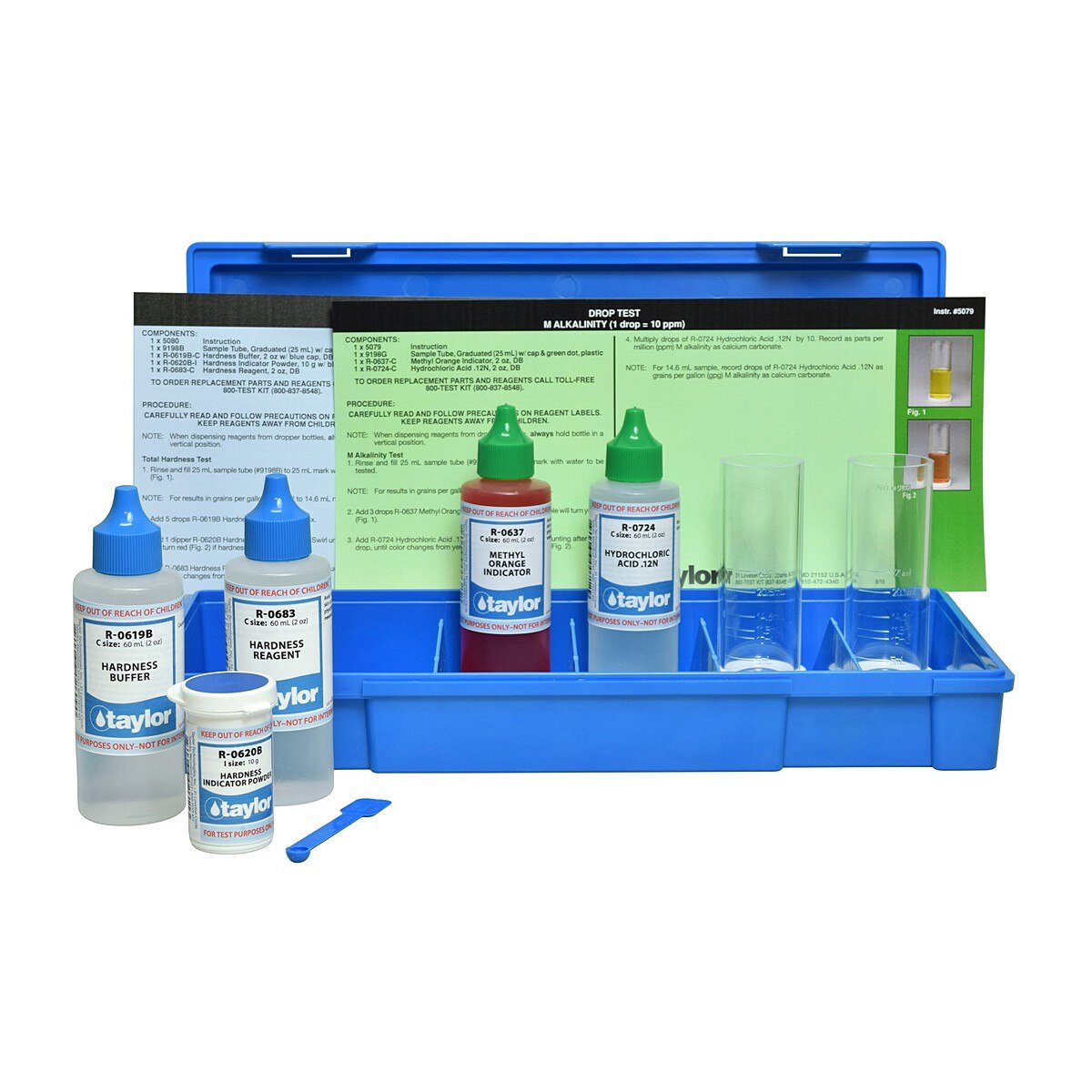
Taylor Boiler/Cooling Systems Test Kit, Alkalinity, Hardness
| Description of Tests |
| Test | Code | Method/Chemistry | Standard/Equivalence or Description | Comparator | Cell | | Alkalinity, M | Drop Test | Methyl orange | 1 drop = 10 ppm M alkalinity as CaCO3 | NA | 9198G | | Hardness, Total | Drop Test | EDTA titration (includes inhibitors to prevent metal interference) | 1 drop = 10 ppm total hardness as CaCO3 | NA | 9198B |
|
Alkalinity is the acid-neutralizing capacity of water. Although many bases (such as borates, phosphates, and silicates) contribute to a water’s alkalinity, it is primarily a function of the carbonate, bicarbonate, and hydroxide concentrations. Alkalinity control is important in many processes including municipal water and wastewater treatment, paper and textile manufacturing, commercial laundering, warewashing, beverage production, and boiler and cooling system operation.
Alkalinity is determined by titration with a standard acid to a designated pH and recorded as either P, M, or T alkalinity. P alkalinity is titrated to an endpoint pH of 8.3 using phenolphthalein as the indicator, M alkalinity is titrated to an endpoint pH of 4.6 using methyl orange as the indicator, and T alkalinity is titrated to an endpoint pH of 4.5 using a blended indicator (bromocresol green/methyl red). If sulfuric acid is being added to modify pH, it will also alter the P/T alkalinity relationship.
To prevent corrosion and scale in boiler and cooling water systems, it is essential to analyze both the natural impurities of the source water and the treated water’s characteristics. The analytes most commonly tested are alkalinity, chloride, hardness, nitrite, pH, silica, and sulfite. Additives such as EDTA and other chelants, molybdenum, phosphates, phosphonates, and polyacrylic-acid-based polymers are also routinely monitored.
Tests for these parameters constitute Taylor’s combination kits for water treatment professionals. Kits come complete with all necessary reagents and equipment.